
Tim Engle Tim Engle

The $1,000 Bill: An Unexpected Call, a Problem to Solve, and a Piece of American History

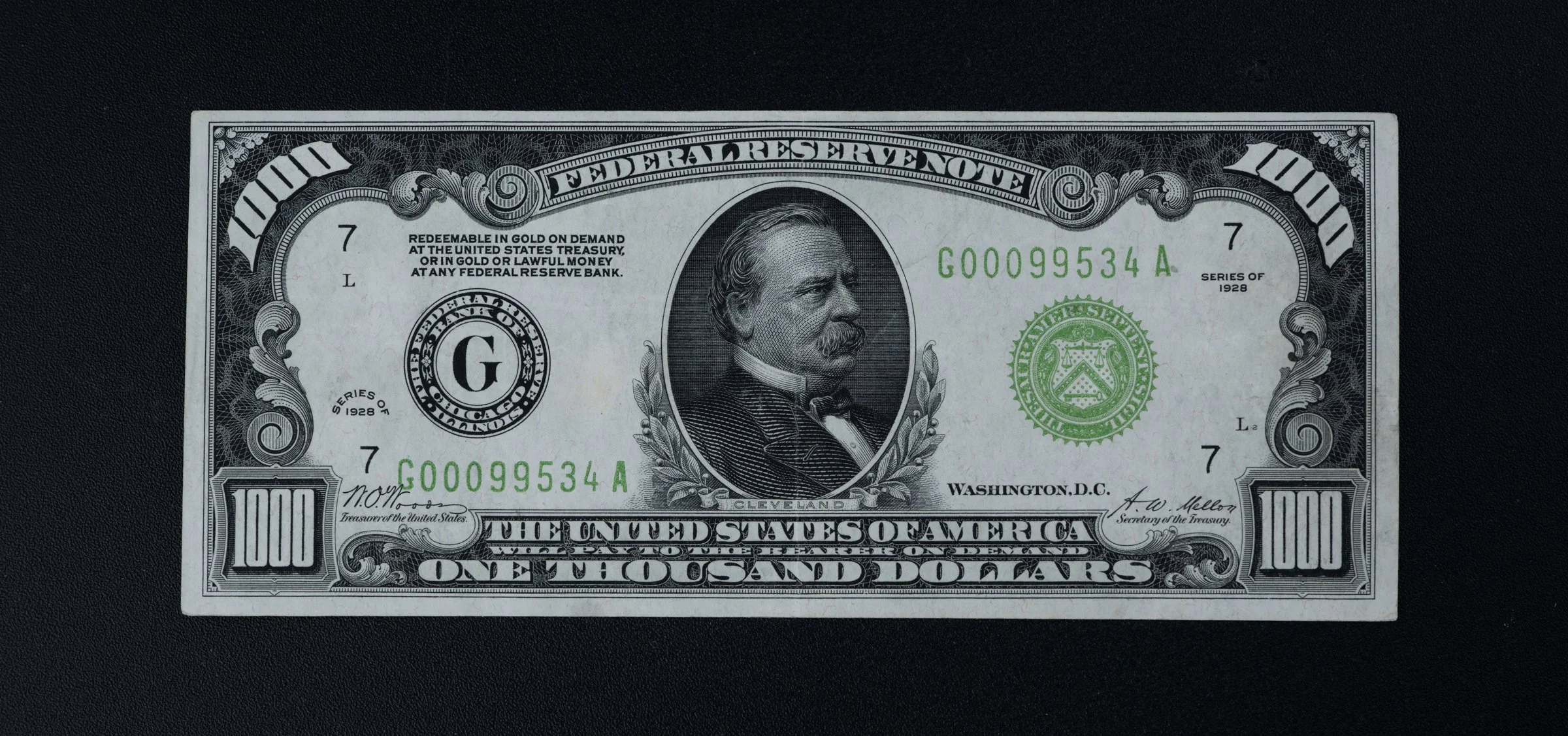
Got a rush call from the gym: photograph a rare 1928 $1,000 Federal Reserve Note for a charity auction. The catch? It was sealed in acrylic. How I solved the problem, and what I learned about a piece of American financial history.

It was morning. I was at the gym.

Series 1928 $1,000 Federal Reserve Note from Chicago Federal Reserve District featuring President Grover Cleveland

My phone buzzes. A guy I don't know is calling with a rush job: he needs a rare $1,000 bill photographed—today—for a charity auction happening soon. High stakes, short timeline, and he's already got it locked in acrylic framing for protection.

Or so I thought.

The First Problem

When we talked through the shoot, he mentioned the acrylic case. I asked the obvious question: "Can you remove it?"

"No," he said. "It's sealed."

That's a problem. Acrylic reflects light like crazy. You get glare, reflections of your lighting rig, and bounced highlights that bury the detail you actually want to show. Shooting through an acrylic case wasn't going to work—not for a collectible that needs to look sharp and clear for auction bidders.

"Here's what we do," I told him. "Meet me at the studio. I can control the environment there, work around the acrylic, and I'll shoot tethered to the iPad so you can see the results in real time, and we can make adjustments on the fly. You'll have the image in minutes, not days."

He agreed.

Preparation: Problem-Solving with Prop Money

I hung up and started prepping. I had prop money at the studio—realistic enough for positioning and lighting tests. I got the camera set up, dialed in my lighting for detail and clarity, and had the prop bill positioned exactly where it needed to be. Everything is staged and ready.

Why? Because when he arrived with the real thing, I wasn't going to waste his time fumbling around. We'd go straight into the shot.

The Moment of Trust

When he showed up, I discovered something great: the acrylic case could actually open. That changed everything—no reflections to fight, clean angles, full control.

But here's where I made a deliberate choice: I had him swap out the prop money for the real bill himself.

I wasn't touching a $1,000 Federal Reserve Note. Not because I don't know how to handle valuable items—I do—but because there's no reason to introduce myself into the liability chain. He owns it, he's responsible for it, and the less contact the better. I directed the shoot, managed the lighting, and he made sure the bill stayed secure. Clean division of responsibility.

Tethered to the iPad, we shot. Checked the results in real time. Made adjustments. In under an hour, we had the images he needed.

What I Learned About the Bill

Afterward, curiosity got the better of me, so I dug into the history of what we'd just photographed.

This is a Series 1928 Federal Reserve Note—specifically, a $1,000 bill issued by the Chicago Federal Reserve District (marked with a "G" on the face). It features President Grover Cleveland, one of only two U.S. presidents to serve two non-consecutive terms. The smaller format you see here was the new standard starting in 1928—a shift from the oversized bills that came before. The Smithsonian has an example in their National Museum of American History collection.

Back then, these weren't oddities. High-denomination bills like $1,000, $5,000, and $10,000 were real currency, used for major bank transactions and redeemable in gold on demand. They were as legitimate as a $20 bill today. But by the 1960s, as electronic banking took over and concerns about counterfeiting grew, the Federal Reserve phased them out. In 1969, they officially stopped printing high-denomination bills. Production officially ceased, and today they're out of circulation.

That makes this particular note a piece of American financial history—still legal tender, but worth significantly more to collectors than its face value.

Why This Matters

This job ranks up there with the most interesting requests I've done. It's not a headshot. It's not a product shot in the traditional sense. It's specialized work: high-value items, meticulous detail, problem-solving on the fly, and the trust that comes with handling something irreplaceable.

It's also a reminder that photography work isn't just about saying "cheese." It's about understanding the challenge, setting up the right environment, and delivering exactly what the client needs under pressure.

If you've got something valuable, rare, or historically significant that needs to be documented—whether it's for insurance, auction, or just preservation—that's the kind of problem I solve every day.


Read More