Tim Engle Tim Engle

Yellowstone Through a Photographer's Eye — What the Park Taught Me About Seeing

A Sacramento photographer's first visit to Yellowstone — chasing bison through geothermal steam, shooting Old Faithful in a storm, and remembering why photography still matters.
Yellowstone Through a Photographer's Eye

Lower Falls of the Yellowstone River viewed from Artist Point, Grand Canyon of Yellowstone National Park

Our recent family trip covered more than 3,400 miles across California, Nevada, Utah, Wyoming, Colorado, Montana, and Idaho. The reason was deeply personal — our son Ryan graduated from the University of Wyoming with a degree in construction management and commissioned into the United States Army. Having our entire family together for that made the whole experience meaningful in ways that are hard to put into words.

Two people sitting on a bench overlooking Lower Falls and the Grand Canyon of Yellowstone framed by pine trees

But somewhere during the trip, Yellowstone quietly became one of the most creatively inspiring places I've experienced as a photographer.

A First Visit — and Why One Day Isn't Enough

It was my first time in Yellowstone National Park, and I quickly understood why people come back year after year. The weather shifted constantly during our time there, which turned out to be a gift photographically. Snow moved through the mountains unexpectedly. Steam drifted across geothermal fields. Storm clouds rolled over the Tetons while shafts of light broke through for only seconds at a time. The landscape never stopped changing.

Close-up of a Yellowstone hot spring with vivid turquoise water and orange mineral deposits along the edge

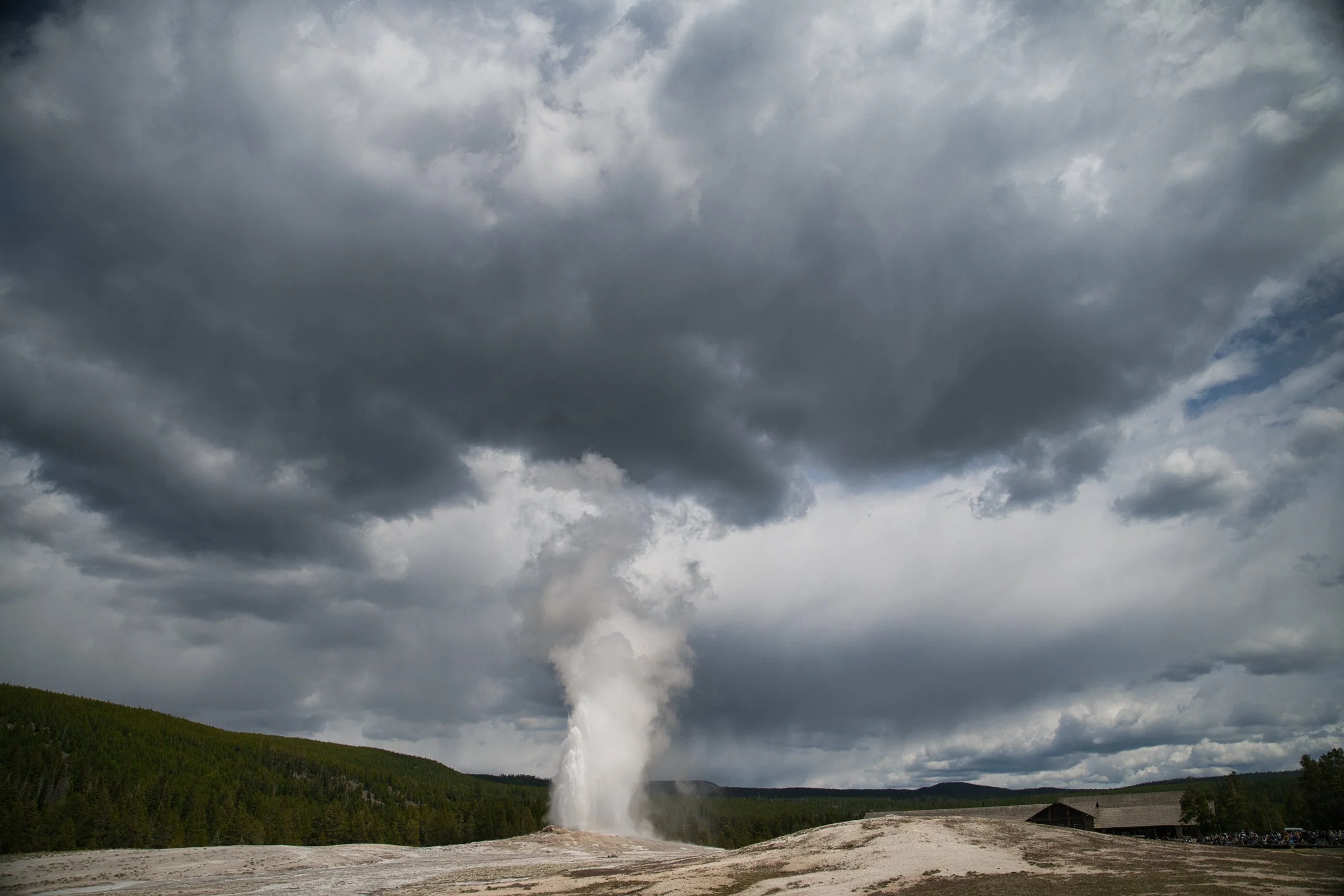
Old Faithful was one of the first stops, and even a landmark that iconic earns your full attention when a storm is building behind it. The sky made the shot.

Old Faithful geyser erupting beneath dramatic storm clouds at Yellowstone National Park, wide landscape view

What Photography Actually Does to an Experience

As photographers, we often hear that cameras pull us out of the moment. For me, it's the exact opposite.

Photography immerses me in an environment. It sharpens my awareness of light, weather, atmosphere, movement, and timing. I notice details most people walk right past. In Yellowstone, that feeling was amplified at every turn.

One moment especially stayed with me. I watched a group of bison moving up a hillside near a geothermal steam vent. Almost immediately, I could visualize the exact frame I wanted — if the animals intersected the steam at the right moment. I had seconds. So I sprinted uphill at altitude, lungs burning, laughing at myself halfway through, because photographers probably look genuinely ridiculous chasing moments like this across hillsides and through bad weather.

But photographers understand the feeling.

Bison herd moving through geothermal steam vents in Yellowstone National Park

The Real Reward of Landscape Photography

There's something deeply consuming about the desire to make an image. You wake before sunrise, carry heavy gear, stand in the cold, chase storms, and wait for light that may only last a few seconds — because you know it may never happen exactly that way again.

Geothermal steam venting through a green meadow with pine trees and dramatic storm clouds over Yellowstone National Park

And the truth is, most of those images never get publicly shared.

The reward is often not recognition. It's the experience itself. Watching the atmosphere change in real time. Feeling present enough to recognize something fleeting and respond to it instinctively.

That was Yellowstone for me.

Black and white photograph of burned trees dusted with snow and geothermal steam rising through a Yellowstone forest

Some of my favorite moments came during unsettled weather. Snow drifting through burned forests. Steam rising through trees. Rain moving across distant ridgelines. The drive south toward the Tetons added its own chapter — roads disappearing into storms, light breaking through in narrow shafts, the kind of conditions that make you pull over, whether you planned to or not. The conditions gave the landscape a kind of emotion and weight that changed by the minute.

Highway curving toward the snow-capped Grand Teton mountain range under dramatic storm clouds in Wyoming

At times I found myself staring up at the sky — completely energized by what the light was doing — wondering why everyone around me wasn't equally amazed by what was happening overhead.

Then I remembered something photographers know well:

We often see light before we see anything else.

Black and white photograph of a bison herd grazing across a wide Yellowstone meadow with snow-capped mountains in the distance

A Note on Gear

For photographers reading this — I shot almost everything on the Nikon Z8 with a 24–70, and I kept a circular polarizer on the lens the entire trip. For Yellowstone specifically, it was the right call every time. The effect on water, steam, and sky was significant and not something you can fully replicate in post. If you're planning a trip and debating whether to bother with one, don't debate it. Several of the landscape edits were finished in Luminar Neo, which handles this kind of atmospheric work really well.

Why Yellowstone Still Stays With Me

Two bison sparring head to head on the shoreline of Yellowstone Lake with blue water in the background

Looking back, Yellowstone was more than a beautiful destination. It reminded me why photography still excites me after all these years.

The camera isn't something that distances me from an experience. In many ways, it allows me to enter it more fully.

And maybe that's the real gift photography gives us — not simply preserving moments, but teaching us to truly notice them while they're still happening.

Single visitor walking along a boardwalk surrounded by dense geothermal steam at Yellowstone National Park

Tim Engle is a Sacramento-based commercial and editorial photographer. His work spans corporate headshots, branding, fitness, architectural, and documentary photography across Northern California and beyond.

Read More
Corporate Headshots Tim Engle Corporate Headshots Tim Engle

What to Wear for Your Corporate Headshot | Sacramento Photographer

Practical wardrobe advice from a Sacramento photographer. What to wear, what to avoid, and why bringing options always pays off.
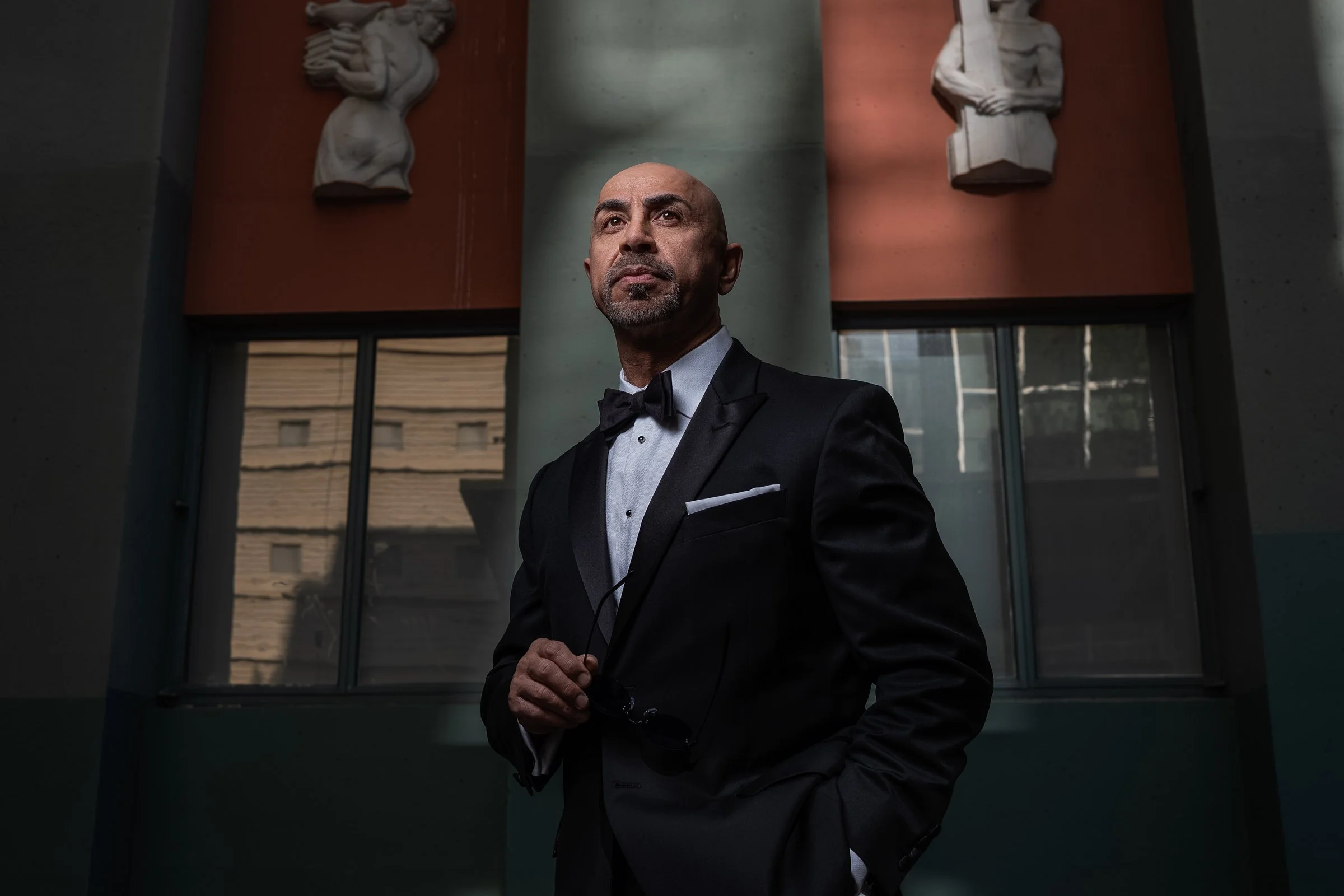
What to Wear for Your Corporate Headshot: Advice from a Sacramento Photographer

The most common question I get before a session isn't about location or timing. It's "what are others doing?" — or some version of "do you have any clothing recommendations?"

After photographing executives, attorneys, medical professionals, and corporate teams across Sacramento and Northern California for years, I've heard it enough times that it seemed worth writing down.

Avoid white and black if you can. White photographs very bright and black photographs very dark. Neither does you any favors against most backgrounds. You don't need to eliminate them entirely, but if you have a choice between a white shirt and a light blue one, go with the blue. Same logic applies on the dark end — navy and charcoal read much better on camera than true black.

Stay away from heavy patterns and logos. A bold stripe or a busy plaid pulls attention away from your face, which is the whole point of a headshot. Logos do the same thing — they become a distraction. Solid colors and subtle textures almost always work better.

Iron everything before you arrive. This one sounds obvious but it gets skipped more than you'd think. Wrinkles that look minor in person photograph clearly. Take five minutes the night before and go through everything you're planning to bring. You'll thank yourself when you see the images.

Bring more than you think you need. More options is always better than fewer. Bring the jacket and the no-jacket version. Bring the blazer and the softer option. Different looks photograph differently depending on the background and lighting, and having choices on set means we can make decisions in the moment rather than working with whatever you showed up in. Nobody has ever complained about having too many options.

What Sacramento executives are wearing right now. For men, navy and gray are the current standard — open collar or a tie depending on your industry. Law firms and financial services can still pull off a tie naturally. Most other Sacramento-area professionals read better without one. For women, blazers and structured necklines are consistently strong. Solid colors in the quiet luxury range — camel, slate, burgundy, forest green — are photographing particularly well right now.

The bottom line. Wear something that feels like you at your best. Not a costume, not something you'd never actually wear to work. The goal is a photo that looks like a polished version of yourself — not a different person entirely.

If you're preparing for an executive headshot session in Sacramento and want to talk through what to bring, reach out before your session. That's what I'm here for.

Book a Session

Read More

Why Photographers Should Still Shoot Personal Work

A recent portrait photography session in downtown Sacramento reminded me why personal work matters. Personal projects allow photographers to experiment with lighting, gear, and creative ideas that often influence their professional portrait work.
Portrait Photography and Creative Growth in Sacramento

At the beginning of this year I spent some time reflecting on 2025 and asking a simple question: what work actually made me happy as a photographer?

Like most working photographers, a lot of my time is spent on assignments. Corporate headshots, editorial projects, marketing images, and portrait photography for clients. That work matters and it keeps the business moving forward. But when I looked back at the year, something interesting stood out.

Some of the photographs I felt the most connected to weren’t assignments at all.

They were the images I made simply because I wanted to make them.

Those shoots usually start with a simple idea: meet a friend downtown, try a lighting concept, experiment with a piece of gear I haven’t used in a while, or explore a location that looks interesting. There’s no client attached to it and no specific deliverable at the end of the day.

Environmental portrait of Sam Altawil in downtown Sacramento photographed with dramatic natural light and strobe.

Ironically, those shoots often produce some of the most valuable work I make all year.

A Creative Reset for Photographers

When you photograph professionally long enough, it’s easy to fall into patterns. Certain lighting setups. Certain compositions. Certain ways of directing people in front of the camera.

Client work often rewards consistency.

Personal work gives you the freedom to break those patterns.

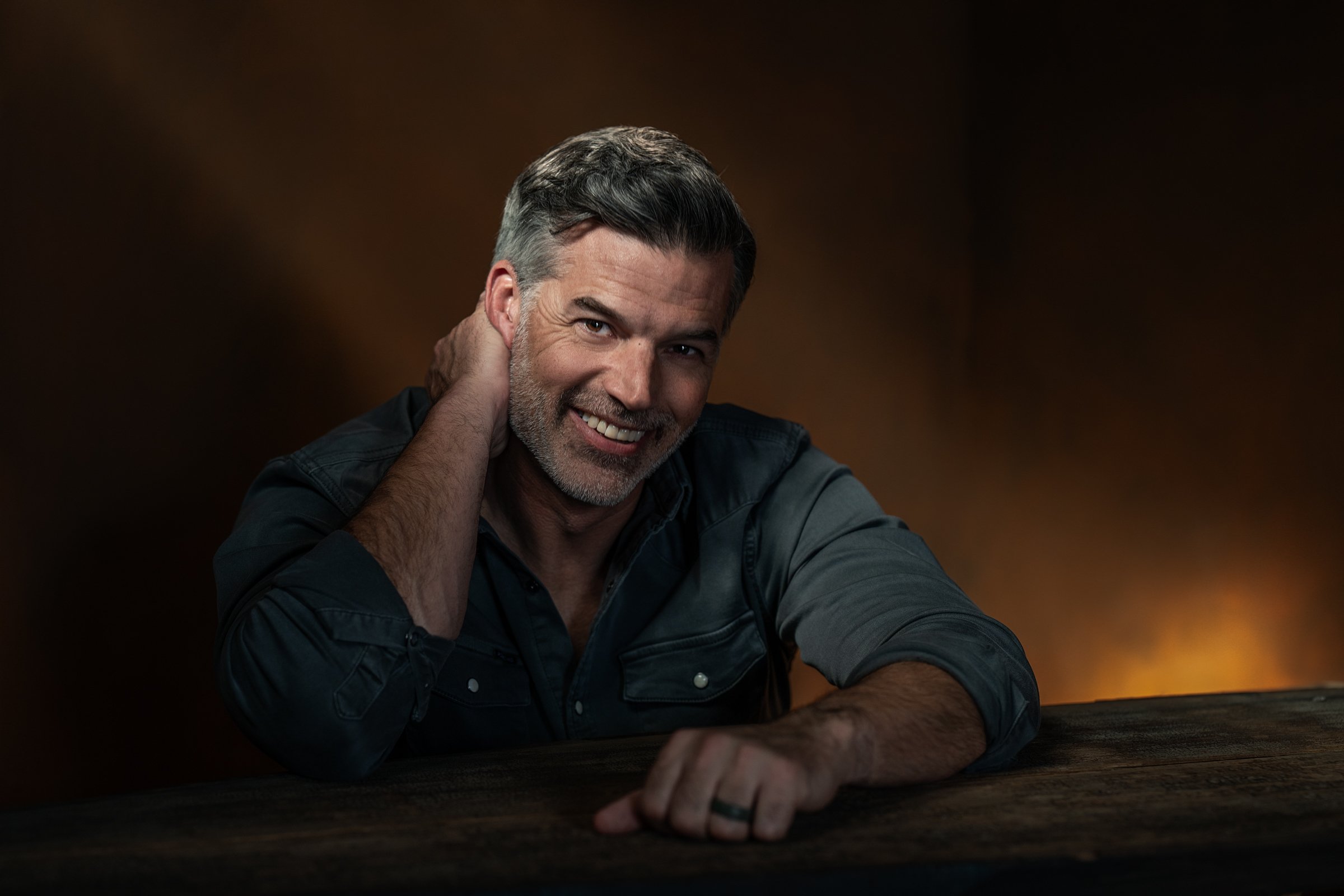
A recent portrait session with my friend Sam Altawil in downtown Sacramento reminded me why that freedom matters. Sam had just picked up a new tuxedo and we thought it would be fun to meet early in the morning and make some portraits around the city.

Portrait of Sam Altawil wearing a tuxedo during a downtown Sacramento portrait photography session.

There was no assignment attached to the shoot. The goal was simply to see what we could create.

That freedom changes the way you approach photography. You notice light differently. You take more risks. You try ideas that might fail. And sometimes those ideas eventually find their way into your professional work.

Experimenting With Portrait Lighting

One of the things I wanted to explore during this shoot was working with a simple lighting setup and letting the environment play a role in shaping the portrait.

Editorial-style portrait of Sam Altawil photographed in downtown Sacramento using natural reflections and off-camera lighting.

Downtown Sacramento is a great place for portrait photography because light reflects off glass, concrete, and nearby buildings. Those reflections create natural patterns of light and shadow that can dramatically change the mood of a photograph.

By combining a single strobe with the reflections already present in the environment, the lighting becomes more dynamic without needing a complicated setup.

Downtown Sacramento portrait photography session with Sam Altawil using a single strobe and natural reflected light.

Shoots like this are where you refine technique. You learn how light behaves in real environments. You see how subtle changes in position affect the mood of a photograph. And sometimes you rediscover gear or techniques you haven’t used in a while.

Those lessons almost always carry forward into future assignments.

Changing Up the Gear

For this shoot, most of the images were made using the Fujifilm GFX50S II paired with a 50mm lens.

The 50mm isn’t a lens I use all the time on that camera system, which made this the perfect opportunity to pull it back out and spend some time working with it again. Like most photographers, I tend to fall into habits with gear and reach for the same lenses repeatedly.

Personal projects are a great excuse to break those habits.

Working with a lens you don’t use every day forces you to think differently about composition, distance, and framing. It’s a small shift, but it often leads to new ideas or perspectives you might not have explored otherwise.

For lighting, I kept things simple and used a Godox AD600 Pro, which has been a rock-solid light for me for years. I’ve worked with a lot of different lighting systems over time, and the AD600 Pro has proven to be incredibly reliable on location.

The light was paired with a Phottix G-Capsule 85cm softbox, which provided a soft, controlled light source while still being compact enough to move quickly between locations.

That combination made it easy to work fast while still shaping the light in a way that complemented the architecture and natural reflections around us.

Another benefit of personal shoots like this is that they allow you to put your gear into situations you might not normally encounter on an assignment. That kind of experimentation keeps you comfortable and confident with your equipment.

Photography Is Also About People

There’s another benefit to personal projects that often gets overlooked.

They reconnect photography with people.

When photography becomes your profession, it can start to feel transactional. Clients, schedules, deliverables, timelines.

Personal shoots bring back the human side of the craft.

Meeting a friend early in the morning to make photographs feels very different from walking into a scheduled assignment. Conversations are relaxed. Ideas flow naturally. And sometimes the best images happen between poses rather than during them.

That kind of environment often produces portraits that feel more authentic.

Personal Work Often Becomes Your Best Work

Another interesting thing happens with personal photography projects.

Because they’re driven by curiosity instead of obligation, they often attract more attention.

Some of the images people comment on the most—whether online or in person—come from shoots that started as nothing more than experimentation. Other photographers notice the lighting. Clients notice the style. Models notice the energy of the images.

In many ways, personal work becomes the work that defines your voice as a photographer.

Moving Forward in 2026

One of the things I realized while reflecting on last year is that personal work shouldn’t be something you do only when you have spare time.

It should be part of the creative process.

Going into 2026 I’m making a point to schedule more of these shoots—meeting interesting people, exploring locations around Sacramento, and experimenting with portrait lighting and ideas.

Not because a client asked for it.

But because that’s often where the most rewarding photographs happen.

Behind the scenes photo of photographer Tim Engle and Sam Altawil during a portrait photography shoot in downtown Sacramento.

Great morning in downtown Sacramento making portraits with my friend Sam Altawil.Sam had just picked up a new tuxedo and it felt like the perfect excuse to head downtown and make a few images. We kept the lighting simple and just explored the city for a while seeing what we could create.

Shoots like this are always a good reminder of why I started photographing in the first place.

Good friends, good light, and a camera.

And in many cases, those personal projects end up shaping the way I approach portrait photography, lighting, and creative direction in my work as a Sacramento photographer.

Read More

Looking Back at 2025 . . . Finding Rhythm, Balance, and Purpose

2025 was a year of rhythm—refining executive portrait work, improving workflow, and staying grounded through meaningful personal projects that continue to shape how I approach photography.
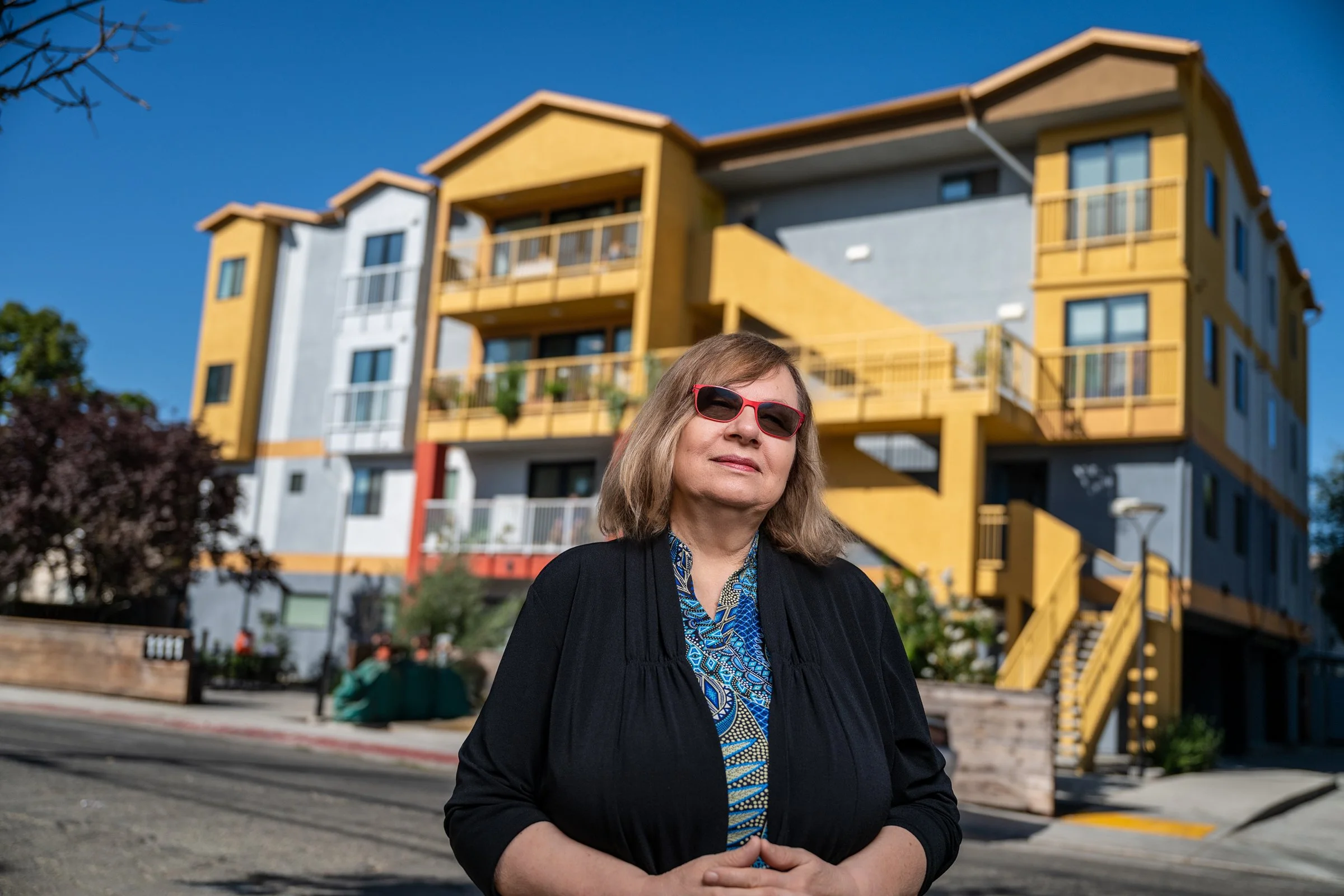
As January comes to a close, it feels like the right time to pause and look back at 2025. It was a year filled with a wide range of projects, shifting environments, and steady growth—both professionally and personally.

From a work standpoint, executive and corporate portraits made up a significant portion of the year. While I’ve photographed people for decades, something about the rhythm of this work really settled in over the past year. Whether it was a single executive or a team of seventy, the process became more refined, more efficient, and more consistent.

One of the realities of corporate portrait photography is time. Sometimes you get to slow down, connect, and build rapport. Other times, you may have five minutes—or less—with each person. In one case this year, I photographed roughly seventy individuals in a single afternoon. Experiences like that don’t allow for hesitation. They require preparation, adaptability, and the confidence to execute under pressure.

That confidence comes from repetition. Years of working quickly, solving problems on the fly, and knowing my gear inside and out have made it possible to walk into almost any situation and deliver. One project in San Francisco summed that up well. I had planned for a large conference room and instead found myself working in a standard hotel room with low ceilings and tight space. With executives rotating through on a strict schedule, there was no margin for error. The lighting plan had to change, and it had to work immediately. It did.

While assistants are invaluable in many scenarios, I’ve also learned that my system is dialed in enough that, in some cases, working solo is actually more efficient. Setup and breakdown are faster, decisions are immediate, and the process stays streamlined.

What continues to draw me to portrait work is the interaction itself. Occasionally, that connection happens fast. Other times, it happens before the camera ever comes out. One client and I talked for nearly thirty minutes before taking the first photo. That wasn’t intentional—it just happened. But once the camera came up, the conversation continued. The result was a relaxed, natural session that felt less like a photoshoot and more like a dialogue. That comfort always shows in the final images.

Professional portrait of a smiling man with salt-and-pepper hair leaning forward, photographed in a studio with warm, dramatic lighting.

From a technical standpoint, one of the biggest improvements in 2025 was workflow. Editing tools and smarter processes have significantly reduced turnaround time without sacrificing quality. Jobs that once took days now take a fraction of that time, which benefits both my clients and me. Efficiency matters, especially when handling high-volume corporate portrait sessions with tight deadlines.

On a more personal level, 2025 marked a significant shift in perspective. Being baptized Catholic and finding a stronger footing in my faith has influenced how I approach my work. It’s less about taking every project that comes along and more about asking whether the work aligns with my values. That clarity has made it easier to say no when something doesn’t feel right—and more confident saying yes when it does.

Balance was another theme this past year. While photography always carries a degree of uncertainty—doing everything “right” doesn’t guarantee the phone will ring—it’s a career that requires constant effort and resilience. Not everyone is built for that. I’m aware of the pressure that comes with it, especially when one successful year leads directly into the question of doing it all over again.

That’s where personal projects come in.

Some of the most meaningful work I did in 2025 wasn’t commercial at all. Spending a day embedded at Mahon Ranch, or documenting multiple days with my son’s ROTC unit in Wyoming, reminded me why I started photographing in the first place. Those projects allowed time—time to observe, to listen, and to understand the heartbeat of a place or a group of people. That kind of work pushes me creatively and keeps me grounded.

As I look ahead to 2026, I want to continue building on what worked: efficient, high-quality corporate and executive portraiture paired with intentional personal projects that challenge and inspire me. That combination is what keeps the work honest, sharp, and sustainable.

Thanks to everyone who trusted me with their image, their time, and their stories in 2025. I’m looking forward to what comes next.

Read More
Deep Thoughts, Photo Life Tim Engle Deep Thoughts, Photo Life Tim Engle

Why I Enjoy Photography More Than Ever

After years behind the camera, I find myself enjoying photography more now than when I first started. The technical side — lighting setups, exposure, gear quirks — no longer slows me down. Those things are second nature at this point, which means I can focus on what matters most: connecting with people.

After years behind the camera, I find myself enjoying photography more now than when I first started. The technical side — lighting setups, exposure, gear quirks — no longer slows me down. Those things are second nature at this point, which means I can focus on what matters most: connecting with people.

Most of my sessions feel like a conversation. We’re talking, laughing, learning about each other — and I just happen to be taking pictures in the middle of it. That shift has completely changed how I experience my work.

August review

August is always a little quieter in photography. Families are on vacation, kids are heading back to school, and businesses are focused elsewhere. Years ago, that slowdown used to stress me out. These days, I plan for it. The truth is, the “slow” months often give me the space to enjoy the projects that do come through.

Here are a few highlights from last month:

Corporate Headshots and Branding Photography in Sacramento

I worked with several professionals and businesses on portraits and branding sessions. Headshots are one of my favorite types of photography because they’re about more than just looking polished — they’re about creating an image that feels authentic and approachable.

Editorial Assignments

Editorial photography always brings something new. August included community profiles and business stories, the kind of work where you step into someone else’s world and capture what makes it unique.

Product Photography

Even something as straightforward as product photography — like a custom knife shoot I did last month — is a creative challenge. The goal is to make an object stand out and give it personality through light and composition.

Sports Photography: Friday Night Lights and Flag Football

High school football is back, and covering Casa Roble under the Friday night lights continues to be a passion project. This year also marked my first season covering girls’ flag football — one of the newest high school sports programs in California. Watching that grow from the start has been energizing to document.

Planning for the Cycle

August may be slower, but I know September and October will pick up fast. December is always a wildcard — sometimes steady, sometimes quiet. Instead of worrying about it, I’ve learned to embrace the cycle and prepare for the dips. That shift in mindset has made the work far more enjoyable.

Looking Ahead

From headshots and editorial shoots to product photography and Friday night football, August may have been “slower,” but it was far from boring. Each assignment reminded me why I love this work — and why, after all these years, I enjoy photography more than ever.

If you’re looking for corporate headshots, commercial photography, or sports coverage in Sacramento, I’d love to connect.

Read More
Behind the scenes, Location, Editorial Tim Engle Behind the scenes, Location, Editorial Tim Engle

Mahon Ranch Cattle Roundup: A Day Inside a 140-Year Sacramento County Working Ranch

There’s a kind of clarity that only comes after spending a full day in the dust, heat, and rhythm of a working ranch. Watching generations of cowboys handle 120 head of cattle—not for show, not for nostalgia, but because it has to be done—reminds you what real work looks like. This wasn’t a photo op. It was a way of life. And I was grateful to be invited into it, camera in hand, just trying to do it justice.

The sun wasn’t high yet when the first gate clanged open. By then, the dust was already rising and the air carried that familiar weight of work. Out here, the job doesn’t wait for comfort. It gets done because it has to. That’s just the way it’s always been.

Jason Mayan rides alongside his daughter Mary at first light—a proud father guiding the next generation in the rhythm of ranch life.

The roundup at Mahon Ranch was underway. Roughly 120 head of cattle would pass through the chute before the heat gave way to evening. Vaccines. Ear tags. Eye treatments. Castrations. There was no ceremony to it—only rhythm. Purpose. And the quiet understanding of people who know exactly what needs to happen next.

They came in on four-wheelers and horseback. The machines cut through the open fields fast, but once the herd funneled into the corrals, it was the horses that mattered. They moved on instinct—a shift in the rider’s weight, a soundless signal. No commands shouted. Just trust built over time.

Cowboy Kona—steady in the saddle and generous in spirit. None of this would’ve happened without his invitation. Grateful for the trust and the open gate.

Troy Mayan on the quad, Kona on horseback—two generations, two approaches, one goal. Different tools, same mission: keep the herd moving and the tradition alive. Tyler Anderson holds the line on the far left, steady as ever.

I was there to photograph it. Not as a tourist, not as a guest—but as someone trying to blend in, earn trust, and get the kind of images that don’t happen unless you’re standing in the same dirt. Literally. At one point, a calf broke loose and it took three cowboys to wrestle it down. I swung my light, dropped to a knee, and framed the moment. Only later did I realize I’d knelt straight into a pile of fresh cow shit. That’s the price of a good photo. It didn’t even register.

Out here, you’re not just documenting a process. You’re stepping into history. The Mahon family has worked this land since 1882, when John Mahon purchased it and began raising hops. By 1890, it was one of the largest hop ranches in Sacramento County. Over time, hops gave way to wheat, cattle, and a way of life that ran deeper than profit margins. Four generations have lived and worked here—through Prohibition, war, drought, and inflation. Some things changed. Many didn’t.

The man I rode out with in the morning, Jack Mahon, told me stories of getting two weeks off school for harvest season. Everyone had a job. That was just life. A far cry from today, when most people driving down Grant Line probably have no idea a working ranch even exists beyond the trees.

That absence of recognition doesn’t bother the Mahons. They don’t chase attention. They just do the work. As Tom, one of the core men behind the operation, put it: “We were raised that the ranch comes first, then your family, and yourself a distant third.” Brutal? Maybe. But it’s how this place has endured.

Tom showed me a knife—an old one, worn and stained. He found it when he was 11 or 12, buried in a muddy riverbank. He gave it to his dad, who cleaned it up and gave Tom his own knife in return. They used the riverbank knife for castrations from then on. Still do. Thousands of bulls have passed through that blade. There’s history in its edge, and in the way it gets passed from hand to hand without fanfare.

Tom holds the same knife he’s used for decades—found as a boy in the mud near a riverbank, it’s become part of the ritual. Tools come and go, but some earn their place through time, grit, and tradition.

Many of the men working that day will likely carry this ranch into its next chapter. Jason. Tyler. Troy. They moved among the herd with purpose, some of them sons or nephews, others brought in through blood or bond. No one was just standing around. Everyone had a job. And there was no need to say much.

Tracy Lynn Mainville, Kona’s girlfriend, handles the chute with focus and calm. Like most on the crew, she jumped in wherever needed without hesitation.

Allysa Biddle doesn’t miss a mark. One hand on the brand, the other on break time — just another day at Mahon Ranch.

This wasn’t a public-facing event. It wasn’t a show. It was the kind of day that leaves your clothes stiff with dust, your hands raw, and your boots heavy. And yet, I loved every minute of it.

Some of the photos won’t make it into the public eye—not because they’re bad, but because they’re raw. Bloody tools. Split ears. A calf thrashing under the weight of three men. That’s the truth of it. Ranch work isn’t sanitized. It’s physical. It’s sometimes brutal. But it’s always done with care. You don’t put your hand on a tool like that without respect.

This is a way of life shaped by calloused hands, early mornings, and decisions that outlive the ones making them. You can feel it in the gates, the fence lines, the worn saddle leather. You can feel it in the way they look out over the fields, always measuring, always remembering.

The ghosts of cowboys past still roam this place. And every time someone swings a gate, ropes a steer, or drops to a knee beside a calf, they pay tribute.

My thanks to Cowboy Kona for the introduction and to the Mahon family for letting me into their circle, even briefly. I’ll be back. With my cameras. And probably with cow shit on my boots.

Tom Mayan and his son Troy — two generations bound by dirt, grit, and a deep loyalty to the land. One raised on the ranch, the other raised by it. Tradition doesn’t just continue here — it stands shoulder to shoulder.

Photographer Tim Engle and rancher Tom Mayan together at Mahon Ranch cattle roundup Sacramento County California July 2025

Two trades, same principles. Tom with his pocketknife—broken in by decades of work. Me with two cameras—still trying to keep up.

Technical Note

This was a self-assigned project—something I believe every working photographer should make time for. It wasn’t for a client, a publication, or a paycheck. It was driven by curiosity, respect for the craft, and a desire to tell a story that deserves to be told.

The images were captured using a Nikon Z9 with a 70–200mm lens and a Nikon Z8 with a 24–70mm lens—both dependable tools in fast, dusty, and physically demanding conditions. Lighting was added with a Godox AD600 strobe and a Phottix deep dish to push through harsh midday sun. I used a Cotton Carrier 3G harness to manage both cameras comfortably throughout the day, and each lens was fitted with a circular polarizer for better control of tone and reflection.

Sometimes, the tools help elevate a story. Other times, they just help you keep up.

Ready to go with all my gear thanks for the photo Tracy!

Read More
Family, Personal Tim Engle Family, Personal Tim Engle

From the Sidelines to the Sacraments: My Journey into the Catholic Church

And I thought: If this level of evil is real, then the opposite must also be real. There has to be a corresponding good. There has to be God.

I didn’t have a dramatic moment of conversion—no lightning bolt from the sky. My story isn’t flashy. But it is honest. And it’s been more than 56 years in the making.

Thank you to my friend and fellow photographer Richard Pochop for many of these images.

This past Easter, I was baptized and received my First Communion at St.Clare Parish in Roseville, CA. But the journey started long before that—in conversations, reflections, and small nudges that slowly pulled me from the sidelines and into something deeper, truer, and more alive than I ever expected.

Growing Up Without It

I wasn’t raised in a religious household. My parents occasionally went to church, but faith wasn’t central. I was never baptized as a child. My moral compass was shaped more by personal standards than spiritual ones. I didn’t drink or party—and I still haven’t been drunk to this day. A lot of my friends growing up were Mormon. I admired their values, and one of them—my friend Aaron—is still a close friend. But faith wasn’t a part of my life.

It wasn’t that I didn’t believe. I just never connected with it. No one ever presented it in a way that clicked for me. Looking back, I wonder if my learning challenges—particularly dyslexia—played a role in that. Reading was always mechanical. Comprehension was hard-earned.

Amy’s Steady Witness

One of the biggest influences in my journey was right beside me the whole time—my wife, Amy.

She never pushed. She lived her faith quietly and consistently. She took our kids to church week after week. I stayed home and watched football. I helped the church with photography when asked, and I enjoyed the community—but I never felt like I was part of it.
Amy, however, was always open. She has an incredible depth of knowledge about the Church, and she delivers it with clarity and patience. I could ask her anything—no judgment, no agenda. That became a huge source of support as I slowly began asking more questions and taking faith more seriously.

A Shift in Perspective

One of the moments that opened the door came while I was driving a rental car on a trip to Atlanta. Alone with my thoughts, I found myself reflecting on the sheer amount of evil in the world—especially what we see online and through social media. The way children are harmed, how truth and dignity are undermined, the dark symbolism some of the cultural elite embrace… it struck me.

And I thought: If this level of evil is real, then the opposite must also be real. There has to be a corresponding good. There has to be God.

That simple logic hit hard.

Soon after, I came across Fr. Dan Reehil, a Catholic priest and exorcist who talks openly about evil and spiritual warfare. His practical, unfiltered explanations of the faith made sense to me. He also spoke about Mary—specifically the mutual pain of Christ on the Cross and His mother watching in agony. That reflection stopped me in my tracks. The shared suffering between Jesus and Mary became a turning point in how I saw both of them.

A Growing Devotion to Mary

That insight led to something else I didn’t expect: a growing devotion to Mary.

I never had a strong connection to her before, but the more I learned, the more I came to admire her courage, sorrow, and strength. She didn’t just say “yes” to God once—she stayed present, even in unimaginable pain. She stood at the foot of the Cross and never turned away. That kind of strength speaks deeply to me. I know her guidance will play a large role in my life moving forward.

Learning to Pray

Prayer didn’t come easily. I didn’t grow up doing it, and hearing my own voice in prayer felt uncomfortable. But I kept showing up. Now, Amy and I pray together every night. I’m learning to talk to Jesus like a friend and confidant. It’s still a work in progress, but the relationship is building.

The Rosary has also become meaningful to me. I haven’t made it a daily habit yet, but I’m getting there. Like anything, it takes repetition and intention. The same goes for confession—I haven’t made my first one yet, but I’m looking forward to it. The idea that baptism washed away my past sins is still hard to fully grasp. There’s a lot in my past I’m not proud of. But knowing those sins are gone—that’s humbling and liberating.

Overcoming Challenges with Technology

Because of my dyslexia, reading has always been a challenge. I moved to a large-print Bible and then to a digital one on my iPad, which helped tremendously. I also used ChatGPT to take notes and summarize what I was learning. It became a study partner—something that helped me keep up and truly engage with the material. I may have been the only one in class using those tools, but they made the difference for me. I wasn’t just going through the motions—I was learning.

A Good Head Coach at the Right Time

St. Clare Church in Roseville became my spiritual home. The pastor, Father George Snyder, played a major role in why I decided to go through with baptism when I did—and where I did.

Before I even knew him well, he had already entered our family’s story—he gave my father-in-law Last Rites during COVID, when few could even get into hospitals. That moment left a mark.

But beyond that, Father George has something unique. He has what I call the “X factor.” He doesn’t just preach—he teaches. His homilies are rich with insight, and his passion for the faith, the saints, and the Church’s history (especially as the keeper of relics for the diocese) is contagious.

To use a sports analogy: sometimes, you just need the right coach to get you off the bench. Father George was that coach for me. He got me in the game. And now that I understand how it’s played, I feel like I can step onto any field and hold my own.

That’s not to take anything away from my years at Saints Peter and Paul. I spent many Easters photographing the Vigil there, and I even had the honor of photographing a priest’s first Mass. That church holds a special place in my heart, and always will. One of the people I worked closely with there was Michelle, who coordinated many of the events I photographed. Her dedication, kindness, and organization made every project smooth and welcoming. Even though I wasn’t a committed member of the Catholic faith at the time, those experiences—thanks to people like Michelle—helped me grow in respect for the Church and its people. In hindsight, they were part of what eventually led me to where I am today.

But sometimes you need a different coach-player combination to unlock your potential. That’s what happened at St. Clare.

Surrounded by Faith

I didn’t walk this journey alone. My brother-in-law Michael acted as my sponsor, and I’m incredibly thankful for his steady support. Like Amy, he’s deeply knowledgeable and always open to discussion. I felt totally comfortable asking him anything.

For my godparents, I chose my oldest daughter, Victoria, and my oldest son, Ethan. I know that might seem unusual, but to me, it made perfect sense. Their faith and character are strong, and having them stand beside me during baptism made it feel like a true family milestone.

From Inspiration to Action: A Media Ministry

All of this has led to something bigger—something I never would’ve imagined a few years ago: the beginning of a media ministry.

I’ve worked in photography and videography for years. It’s what I do. But now, I see an opportunity to use those skills for something more eternal. The Church has incredible stories to tell, and many of our parishes aren’t using media to its full potential. I want to change that.

One experience that stands out is my time volunteering with the National Eucharistic Pilgrimage at the end of last year. It wasn’t just a photography assignment—it was a spiritual deepening. I documented the pilgrims’ journey, capturing moments of reverence and joy, and even collaborating with my wife on lighting for some of the images. That experience gave me a profound respect for the dedication of the faithful—and for the power of images to tell a story that words can’t always capture.

I want to bring that same energy to local parishes and beyond, capturing the energy and wisdom of people like Father George, the beauty of our liturgies, and the power of faith-filled lives. If my work can help others see what I’ve come to see—even just a glimpse—it will be worth every minute.

Stepping Fully In

This journey has given me peace I didn’t know I was missing. It’s not that everything is figured out—I still have a long way to go. But I’ve stepped off the sidelines. I’ve been baptized, I’ve received the sacraments, and I’m in the game now.

This isn’t just belief. It’s life. And I’m all in.

Read More